


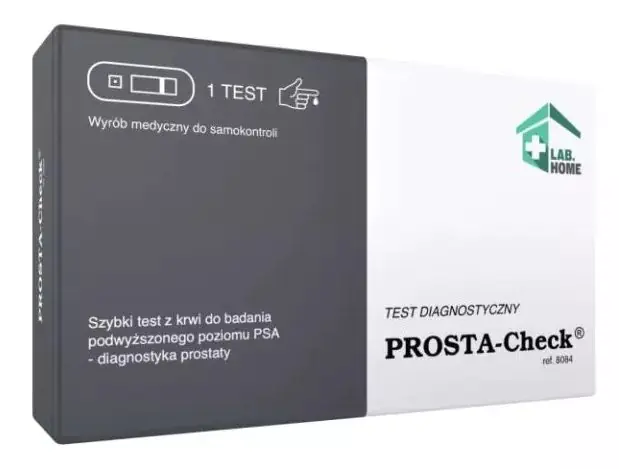

Product Description
What is the LabHome Prosta-Check Test for Detecting Elevated PSA Levels and how does it work?
LabHome diagnostic tests enable early diagnosis or exclusion of many common diseases in the shortest possible time, ensuring the comfort of testing - independently and without leaving home. Additionally, LabHome tests allow for the assessment of the physiological condition of organs, hormone diagnosis, and detection of fertility problems.
Application:
LabHome PROSTA-Check is a specific, rapid immunodiagnostic test for the detection of prostate-specific antigen (PSA). The PSA level in the blood allows for an assessment of the physiological condition of the prostate. A value higher than the norm (4 ng/mL) indicates prostatic hyperplasia. A PSA test should be performed at least once a year in men over 50 or in men with a family history of prostate problems. In the case of prostate problems, early screening allows for treatment initiation and increases the possibility of improvement. The test is also performed as part of prostate/prostate cancer prevention.
How to use:
The testing procedure always begins with good preparation. Place the contents of the box on a clean, dry, and flat surface (e.g., a table), and then:
- Wash your hands thoroughly with soap, rinse under running clean water, and dry them.
- Tear open the aluminum bag along the edge, then remove the test strip and plastic pipette. Place them on a flat surface within reach. Discard the desiccant sachet.
- Prepare the lancing device. Twist the gray cap until you feel it separate from the lancing device—do not pull. Continue twisting (2-3 turns), remove and discard the cap. Do not touch the release button.
- Disinfect the fingertip of your chosen hand and massage for 10-15 seconds towards the fingertip to increase blood flow.
- Press the lancing device firmly against the side of your disinfected fingertip and press the lancet eject button.
- The lancing device tip will automatically retract after use, ensuring safety.
- Gently massage the punctured fingertip to obtain a drop of blood.
- Without pressing on the pipette, bring the tip close to the drop of blood. Blood migrates through the capillary until it reaches the line marked on the pipette. Massage to obtain another drop of blood if the line on the pipette has not been reached. If possible, avoid drawing air bubbles into the pipette.
- Transfer the collected blood to the sample well of the test plate by squeezing the pipette tip.
- Wait 30-40 seconds until all the blood is in the sample well.
- Unscrew the blue cap and add 4 drops of diluent to the sample well (pausing 2-3 seconds between each drop).
- Hold the diluent vertically.
- Read the test result after 10 minutes. Do not interpret the test result after 15 minutes.
Responsible entity details:
ZBADAJSIE SP. Z OO
ul. Norwida 1/2
48-300 Nysa
Comment