



Product description
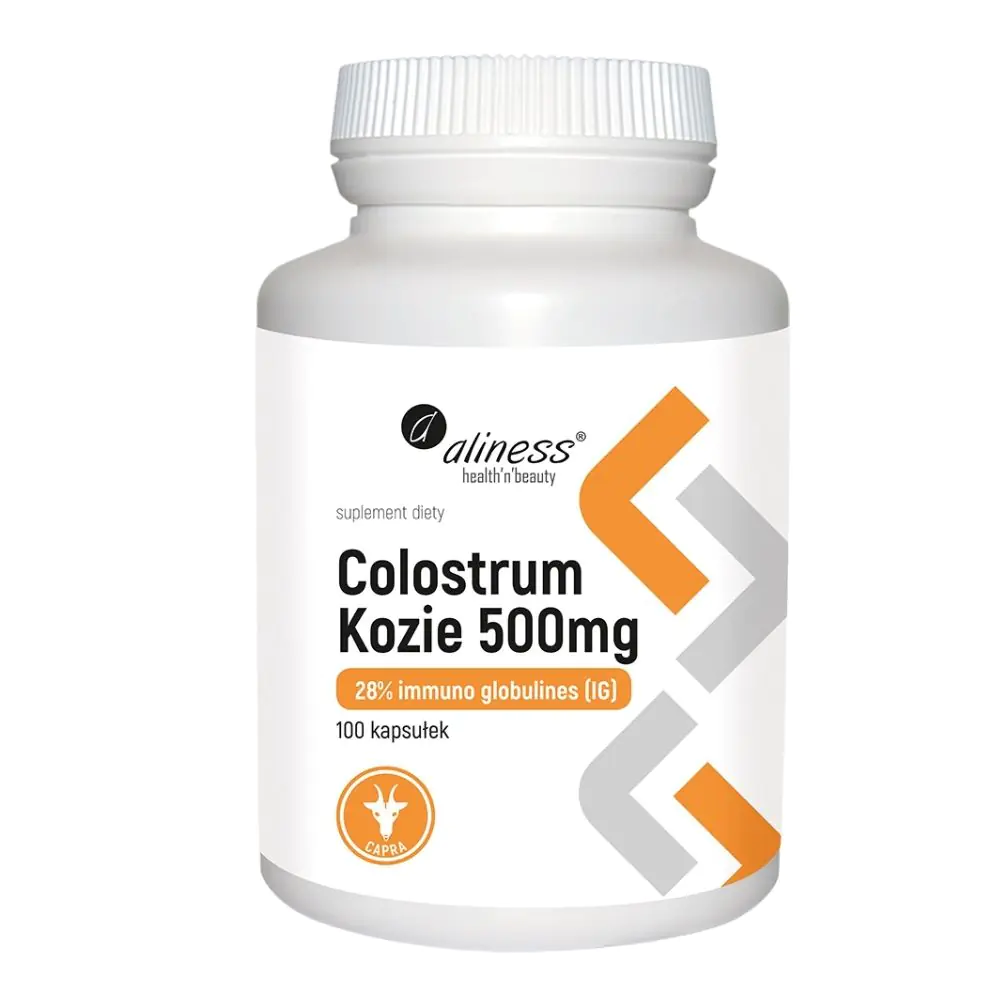
ALINESS GOAT COLOSTRUM 28% IG 500 MG CAPSULES
Alinesse 28% goat colostrum is a dietary supplement containing 500 mg of colostrum in each capsule, of which 28% are immunoglobulins (IG). The product provides a variety of immunoglobulins (IgG, IgM, IgA, IgE, IgD), lactoferrin, PRP (proline), 19 exogenous amino acids, vitamins and minerals.
Ingredient properties:
According to preliminary clinical studies, taking lactoferrin in a preparation composed of an immunoglobulin fraction allowed for a greater reduction in the symptoms of atopic dermatitis than was observed in the placebo group.[1] The combination of lactoferrin with immunoglobulins also contributed to a 57% reduction in the number of colds compared to placebo.[2]
Recommended daily intake:
- 1 to 2 capsules a day, before a meal, with water
- Do not exceed the recommended daily dose
Storage conditions:
- The dietary supplement should be kept out of the reach of small children
- The preparation should be stored at a temperature below 25 ° C
- Protect from light and moisture
Warnings and precautions:
- The dietary supplement cannot be used as a substitute for a varied diet
- Do not take the dietary supplement if you are allergic to any of its ingredients
- Do not use colostrum in children under 3 years of age due to potential allergies to milk proteins.
- Pregnant and breastfeeding women should consult a doctor before using the preparation.
Net quantity:
100 capsules
Data on the marketing authorisation holder:
MedicaLine
Ostrowiec 150
05-480 Karczew
- Tong, PL, West, NP, Cox, AJ, Gebski, VJ, Watts, AM, Dodds, A., de St Groth, BF, Cripps, AW, Shumack, S. (2017). Oral supplementation with bovine whey-derived Ig-rich fraction and lactoferrin improves SCORAD and DLQI in atopic dermatitis. Journal of dermatological science, 85(2), 143–146.
Vitetta, L., Coulson, S., Beck, S. L., Gramotnev, H., Du, S., Lewis, S. (2013). The clinical efficacy of a bovine lactoferrin/whey protein Ig-rich fraction (Lf/IgF) for the common cold: a double blind randomized study. Complementary therapies in medicine, 21(3), 164–171.
Comment